

Introduction
We explore the Lucipara Islands, a remote and rarely discussed group of small islands belonging to Indonesia. These islands are notable not for bustling tourism or large settlements, but for their isolation, maritime importance, and natural marine environment. Located in the eastern Indonesian seas, the Lucipara Islands have long been known to sailors navigating historic trade routes. Their obscurity makes them fascinating to researchers, geographers, and those interested in untouched island ecosystems.
Unlike many well-known Indonesian islands, Lucipara remains largely uninhabited and undeveloped. This has preserved its natural character and added to its mystery. Understanding Lucipara helps us appreciate the vast and diverse maritime geography of Indonesia.
Geography
The Lucipara Islands are situated in the eastern part of Indonesia, within the Banda Sea, a region that lies between the Indian Ocean and the Pacific Ocean maritime systems. Administratively, the islands belong to Maluku Province, an area historically known as the Spice Islands.
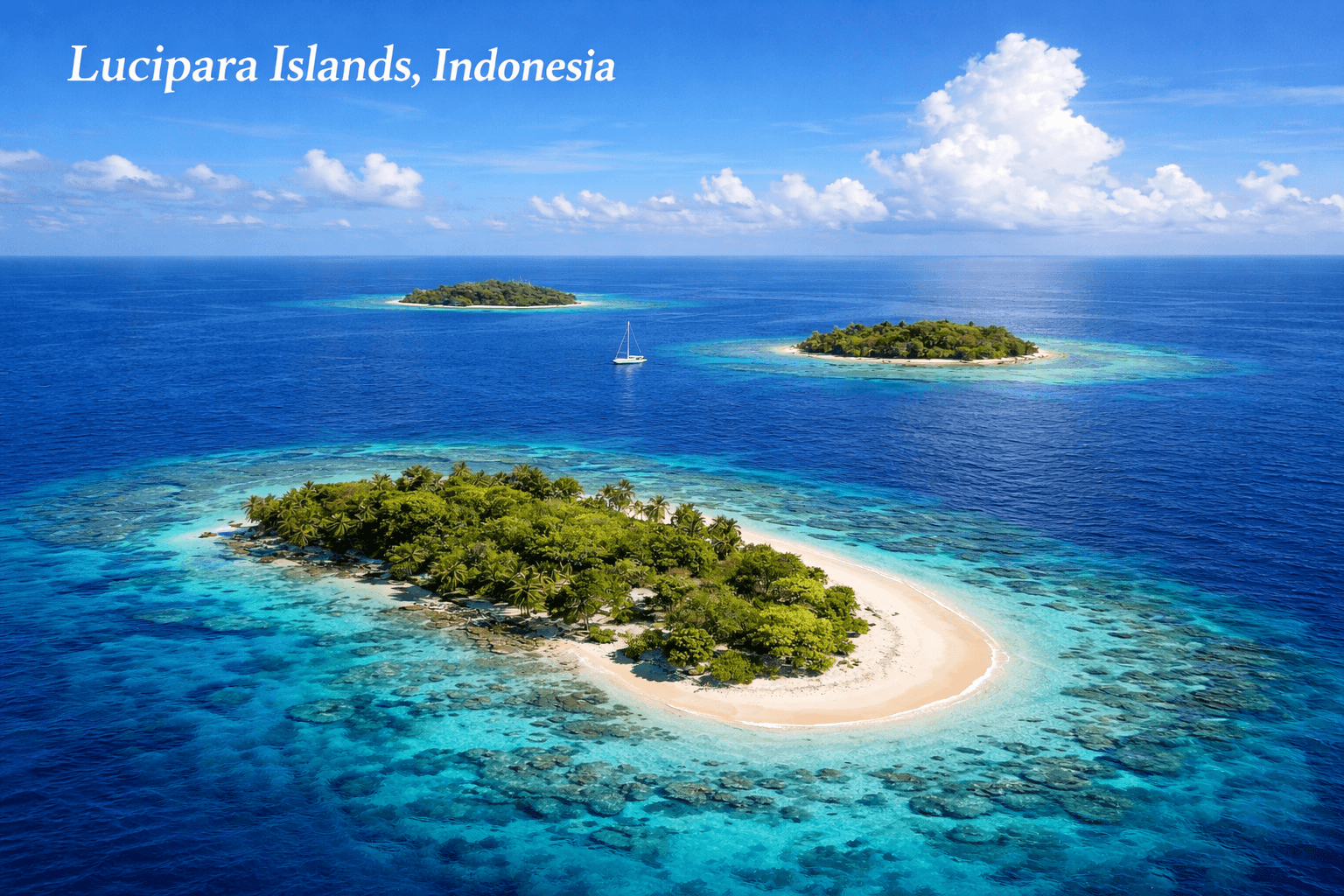
Geographically, Lucipara consists of small, low-lying coral islands rather than large landmasses. The islands rise only slightly above sea level and are surrounded by deep waters. Their formation is typical of coral-based islands found throughout eastern Indonesia, shaped over time by reef growth and marine sediment.
The surrounding waters are clear and deep, making the islands visible hazards to ships but also indicators of healthy coral ecosystems. Due to their size and remoteness, Lucipara does not feature rivers, mountains, or freshwater lakes. Instead, its geography is defined by reefs, shallow coastal shelves, and open sea.
History
Historically, the Lucipara Islands have been known mainly through navigation records rather than settlement history. European sailors and explorers documented the islands during the age of maritime exploration, particularly when the Banda Sea became a major route for spice traders.
The islands were never significantly colonized or developed. Their main historical role was as reference points for navigation and cautionary markers due to surrounding reefs. Ships passing through the Banda Sea relied on accurate charts to avoid running aground near Lucipara.
There is no evidence of permanent indigenous settlements on the islands. Instead, Lucipara appears in history as part of the wider maritime network that connected the Maluku Islands with global trade routes.
Ecology and Environment
The natural environment of the Lucipara Islands remains largely intact. With no urban development and minimal human presence, the islands support a marine-focused ecosystem rather than terrestrial biodiversity.
The surrounding coral reefs are a defining feature. These reefs provide habitats for a wide range of marine life, including reef fish, crustaceans, and other sea organisms typical of the Banda Sea. The area is known for its biodiversity due to the mixing of ocean currents and nutrient-rich waters.
Vegetation on the islands themselves is sparse. Small shrubs, salt-tolerant plants, and limited coastal greenery dominate the land. There are no forests or agricultural zones, reinforcing the islands’ untouched character.
Human and Cultural Notes
There are no permanent residents on the Lucipara Islands. Human interaction with the islands has historically been limited to passing sailors, fishermen, and occasional research or government patrols.
Culturally, Lucipara does not have traditions, architecture, or local communities associated with it. However, it remains part of Indonesia’s vast maritime heritage. Indonesian seafaring culture recognizes such islands as essential markers in understanding sea boundaries and navigation routes.
The absence of human settlement has prevented cultural development but preserved environmental purity.
Access and Tourism
The Lucipara Islands are not a tourist destination. There are no transport services, accommodations, or visitor facilities. Access is only possible by private or research vessels, usually departing from larger Maluku islands.
Nearby urban centers are far away, and travel requires advanced maritime planning. Due to navigational hazards and lack of infrastructure, the islands are unsuitable for casual travel. As a result, Lucipara remains off the radar of mass tourism and adventure travel alike.
This inaccessibility has indirectly protected the islands from environmental damage caused by tourism.
Interesting Facts
- Lucipara Islands are uninhabited, with no permanent population.
- The islands are mainly known from nautical charts and maritime records.
- They are surrounded by deep Banda Sea waters, making them important navigational reference points.
- The islands consist mostly of coral formations rather than volcanic land.
- Lucipara plays a role in defining Indonesia’s maritime geography, despite its small size.
Frequently Asked Questions (FAQ)
Where are the Lucipara Islands located?
The Lucipara Islands are located in eastern Indonesia, within the Banda Sea, part of Maluku Province.
Are the Lucipara Islands inhabited?
No, the islands have no permanent residents.
Can tourists visit the Lucipara Islands?
There is no organized tourism. Visits are limited to private or research vessels.
Why are the Lucipara Islands important?
They are significant for navigation, marine biodiversity, and understanding Indonesia’s island geography.
Do the islands have coral reefs?
Yes, the surrounding waters contain coral reefs that support diverse marine life.
Conclusion
We see the Lucipara Islands as an example of Indonesia’s hidden maritime landscape. Small, remote, and uninhabited, they do not attract attention through tourism or population, yet they hold geographic, ecological, and navigational importance. Their untouched nature highlights how vast parts of the Indonesian archipelago remain preserved simply due to isolation.
Learning about Lucipara expands our understanding of island ecosystems and maritime history. These islands remind us that significance is not always measured by size or development, but by location, natural value, and role within a broader geographic system.
Also Read More


